
Sharon Carson |
It’s not at all surprising that in recent years, readers and activists around the world have turned to the work of Hannah Arendt (1906-1975), a political philosopher preoccupied with human plurality and freedom, with thinking through the contingencies of history, with thinking and acting creatively and collaboratively during times of disruptive change, social conflict, and authoritarian violence.

Arendt argued that a genuinely pluralistic politics was possible via rigorous debate and collective action in shared public spaces, and she was especially outspoken in condemning any attempts to render human beings “superfluous,” hidden from sight, “disposable,” out of the range of public concern and political inclusion. Recognizing the reality that such renderings occur constantly and in many forms, she also tirelessly argued for direct confrontation with injustice and for the positive value of “pariah” status: the outsider lens.
As a Jewish German scholar and writer in the mid 20th century, Arendt had herself been targeted as superfluous, fleeing Germany as a refugee and a politically “stateless person” during the 1930s. After she later settled in the United States (one of relatively few political refugees admitted here prior to and during WWII) she spent her life writing and speaking to advance human rights, to confront “thoughtlessness” in all its catastrophic forms, and to call out the perils of authoritarianism.
Among the many new books about Arendt in the last years, here are just three, all aimed at bringing Arendt’s ideas into focus while keeping a sharp eye on our times and troubles. Readers new to Arendt will also get enough orientation in these books to spark their own turn to Arendt’s many books and essays:
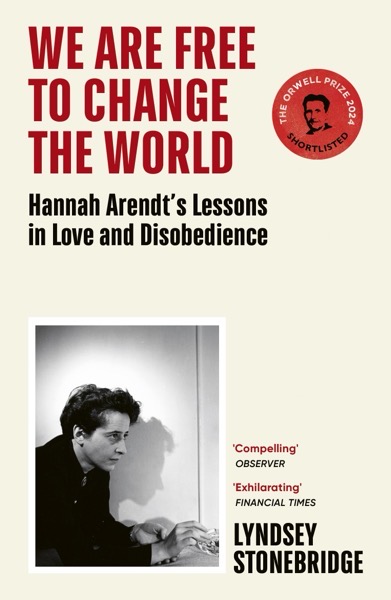
U.K. scholar Lindsey Stonebridge’s latest book We are Free to Change the World: Hannah Arendt’s Lessons in Love and Disobedience offers readers a detailed intellectual history of Arendt’s life, writings and times, in a portrait grounded in today’s world by means of Stonebridge’s own analysis of current refugee crises and migrations caused by wars, civil conflict, economic hopes, and climate catastrophe. Stonebridge is active in several international human rights projects, and her writing is narrative nonfiction at its best: critically engaged, textured and nuanced, experimental, and deeply informed by research and field work.
While highlighting the depth and complexity of Arendt’s work and life, the enduring value of The Origins of Totalitarianism (1951), and Arendt’s lifelong labor as a thinker, writer and activist, Stonebridge also confronts Arendt’s occasional failures to perceive well and think carefully, especially in her writings on race and racism in the United States. Arendt’s infamous poorly informed first writing on the American civil rights movement is one such instance, and Stonebridge gives a full and fair account. But she clearly frames her criticism as a more general cautionary tale (especially in our digital/social-media-soaked days) about the social damage potentially done to others by prematurely speaking publicly about things we don’t know about. And Stonebridge offers up the importance of sincere self-critique and an ability to change one’s thinking by highlighting Arendt’s frank letter exchanges with James Baldwin and more significantly, her unabashed “I was wrong” letter of apology to Ralph Ellison, in the wake of reactions to her 1959 essay “Reflections on Little Rock.”
Stonebridge was also a key advisor on Hannah Arendt: Facing Tyranny, the recently released American Masters PBS documentary.
Another fairly recent book that has been translated from its original German to English is journalist and Arendt scholar Marie Luise Knott’s Unlearning with Hannah Arendt. Knott as social critic also fully engages with international issues today, and she is especially attentive to Arendt’s political use of irony and the importance of “thinking without banisters.” (for more on this key idea, see Arendt’s essays in Thinking without a Banister , edited by longtime Arendt scholar Jerome Kohn)
Knott’s opening chapter “Laughter: The Sudden Turn of the Mind” takes on Arendt’s provocative admission that as she was covering the Adolph Eichmann trial in Jerusalem, circa 1961, she read the interrogation transcripts of Adolph Eichmann and she laughed, startled by his quite literal “thoughtlessness.” Knott takes this moment and builds from it her own exploration of the political power of such startled and disrupted perception, which can unleash our capacity to “unlearn” old habits of thought (and action): “Such acts of ‘unlearning,’ born of shock and distress, are intellectual awakenings.” For Knott, as for Arendt, such ruptured awakenings are prerequisites for clear thinking and political action in times of “shock and distress.”

And finally, there is a new Library of America volume which pairs essays on civil disobedience by Hannah Arendt and Henry David Thoreau, with an introduction by another longtime Arendt scholar Roger Berkowitz. Berkowitz draws parallels and distinctions between these two thinkers in ways that will challenge readers to deepen their own thinking about civil disobedience as a political tactic. Berkowitz also brings his own insights into play in interesting ways as well: for example he does readers the great service of linking Bayard Rustin’s civil rights, labor and anti-war activism to Arendt’s philosophy of civil disobedience, while also relating Rustin and other American thinkers to international human rights activism.
This international and comparative lens is shared by all three of these books, in fact, and could not be more timely.
~
Sharon Carson is former editor of NDQ and a Chester Fritz Distinguished Professor of English at the University of North Dakota.
 North Dakota Quarterly