
Bill Caraher |
As readers of this blog know, I’ve been a bit obsessed with the prairie poet Clell Gannon recently. In fact, I’m working to produce a “centennial edition” of his 1924 book of poems Songs of the Bunch Grass Acres.
As part of that process, I’m doing a bit of reading around in Gannon’s other works and reading some work on Gannon. In fact, this project was inspired by Molly Rozum’s recent book Grasslands Grown: Creating Place on the U.S. Northern Plains and Canadian Prairie (2021). This week, I had the pleasure of perusing Aaron Barth’s very recent dissertation from NDSU, Settler Colonizers’ Sense of History on the Northern Plains Before and After the Turn of the Nineteenth Century from 2022, which includes a chapter on Gannon.
He and his wife’s home in Bismarck, called the Cairn, had become sufficiently iconic to gain a mention in the WPA guide to North Dakota. It was made of native prairie stone and perhaps represented the most literal possible interpretation of the so-called “Prairie School” of architecture. Rather than embracing the prairie as a kind of icon of openness, freedom, and American modernity, Gannon built his home of prairie limestone and instead of referencing the explicit modernity of formal architecture, made a nod to the practice of using stones cleared from fields to build barn foundations.
Barth’s dissertation spent some time discussing Gannon’s 1925 trip on a shallow draft boat down the Little Missouri River from Medora to Elbowoods on the Fort Berthold Indian Reservation. He was accompanied on the journey by George Will and Russell Reid. They then continued down the Missouri River to Bismarck. Gannon published a description of his journey in the first volume of North Dakota History: “A Short Account of a Rowboat Journey from Medora to Bismarck.” Fortunately, you can now read this because it entered the public domain last year.
The narrative is sparse, but the authors had a shared interest in both the scenic and historic aspects of the 350 mile journey. They noted, for example, the historic remains at both Marquis de Morès’s Medora and Theodore Roosevelts Elkhorn ranch as well as the remains at several Mandan villages on the Missouri River downstream from Elbowoods.
One of the more disappointing things to discover is that, as far as I can tell, Gannon never contributed any of his writing to NDQ. He did however contribute some cover art.
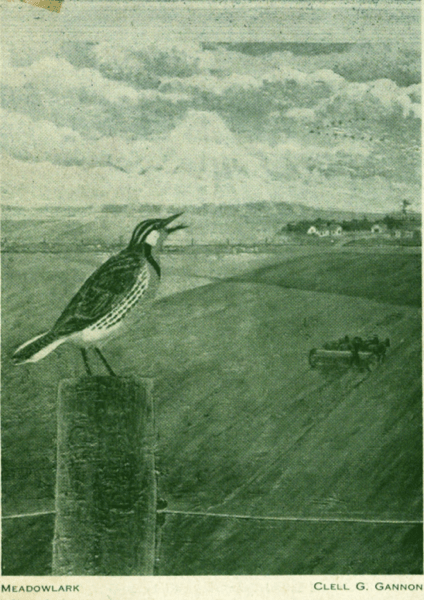
Stay tuned for more Gannon related posts in the future!
~
Bill Caraher is the editor of North Dakota Quarterly.
 North Dakota Quarterly